

Flesh Eating as the Ritualized Enactment of Human Supremacy
Notes towards a manifesto

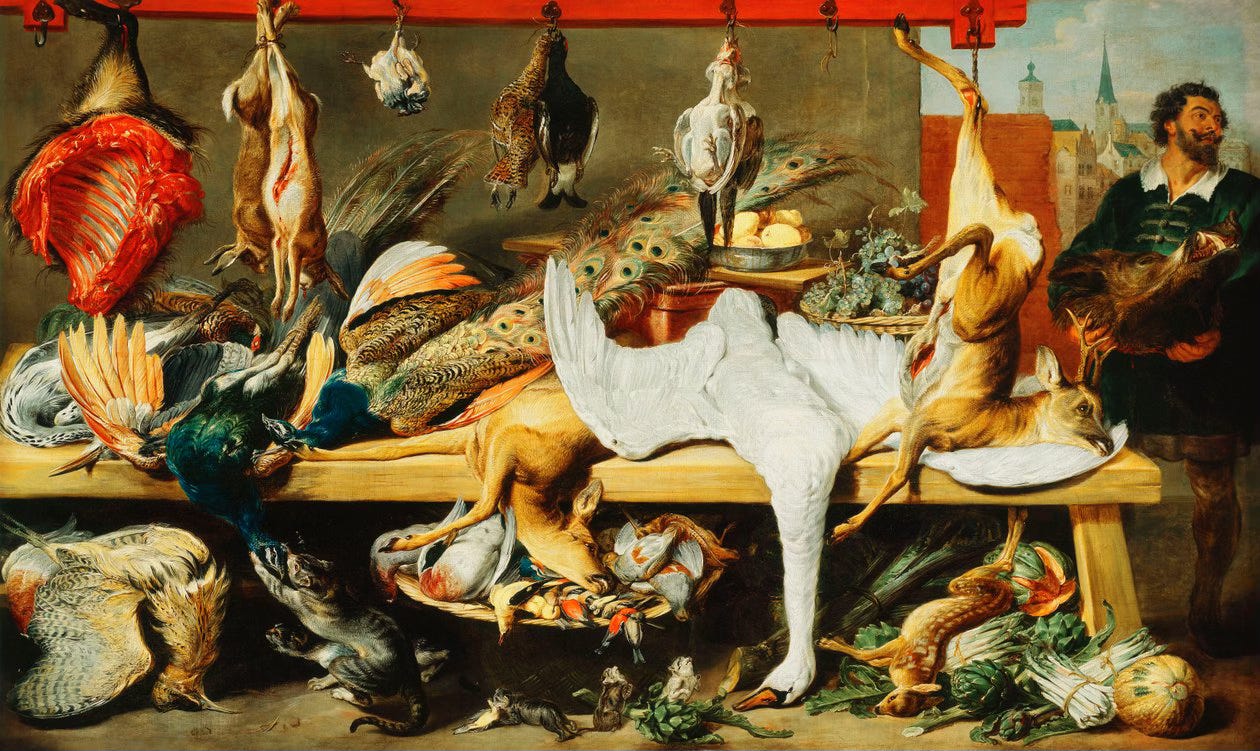
The reasons commonly given for why we all ought to be vegan are not as strong as its proponents seem to think. Even if true that industrial animal agriculture is one of the greatest evils in the world today (which I certainly believe), still it isn’t clear what the individual is required to do about it. To abstain from animal products entirely might, after all, come at a huge cost to oneself while being negligible in terms of its impact on aggregate demand. And sure, we may demand of each individual that they ‘play their part’ in addressing societal ills, but why insist specifically on veganism as the basic non-negotiable obligation that applies equally to each and every one of us? Surely a humanitarian aid worker who travels into warzones and puts their life on the line can be excused if they decide they haven’t the energy to worry also about what not to eat.
And even if we do make it a top priority to reduce animal suffering, still that wouldn’t always necessarily require us to be vegan. Eating animals you have hunted yourself is likely less bad in terms of aggregate welfare than is consuming plants sourced from intensive farming operations (given all the collateral damage caused by the machinery used and fertilizer runoff, etc.). The same goes for roadkill, for flesh that would otherwise go to waste, and of course for cultivated meat.1
And if it turns out that the aversion is simply to the consumption of flesh itself, then veganism may in turn be symptomatic of a desire to extricate ourselves from natural processes characterized by relations of edibility (we eat and are eaten in turn). Surely such an anti-ecological posture can be nothing but self-defeating for a movement that has as its aim to reestablish a more respectful relationship with non-human others.2
For the above-stated reasons, a vegan identity as presently understood provides at best a shaky foundation for the work of animal liberation. There are two ways that I can think of addressing this problem: Either we march on towards a post-vegan animal advocacy, or we entirely rethink what it means to be vegan. Here I want to briefly sketch out what the second approach might look like.

It isn’t necessary that veganism be tied, as it currently is, to the aim of increasing aggregate welfare and/or to a strict condemnation of flesh itself. The former we saw isn’t enough to motivate action; the second can implicate us in potentially regressive and sinister ideologies; and both fumble and waver when it comes to offering prescriptions, dictating proper conduct. But it is possible, I think, to change ‘veganism’s’ object, its essential meaning, while keeping it as a unifying marker of identity and a compelling alternative to the status quo—maybe even morally compulsory for everyone in a western developed society.
So, the following is what I propose: that veganism be thought of primarily as a method, a practice, designed to be maximally disruptive to what is arguably the most foundational and malignant of all false ideologies: Human Supremacy. Let me break this down:
1) Human Supremacy is a perspective, a mode of taking up with the world, grounded on the belief that the possession of ‘Humanity’
makes one essentially distinct from the rest the world,
of greater importance than the rest of creation, and therefore
entitled to the limitless use of all them who are not ‘Human.’
2) Ideologies maintain their hold on us through ritual reenactment. Rituals in turn are characterized by
a progressive inward alignment with a certain value laden perspective, a manner of arranging the world and relating to it,
an exchange whereby one gives something up to obtain another more desirable thing, and
a building up of a material environment that is both conducive to the continuation of such rituals, and that reifies the perspective embodied in them.
3) The consumption of animal flesh in particular is the most central of the complex of rituals that uphold Human Supremacy. Thought of as ritual, the eating of flesh has as its function
the transforming of living subjects into inert and passive matter, upon which our will can be exercised freely,
the projection of our own animality onto the sub-Human other who is then sacrificed as an expiatory offering, thus delivering us from aspects of ourselves that point to our continuity with the natural world, and
the consequent setting up of the Human as master over the subdued and subordinated sub-Human other.
4) In this light, veganism can be construed as a counter-ritual, having as its function
to creatively affirm, forcefully make visible, the subject implicit in the animal flesh prepared for consumption,
the renunciation of the impulse to degrade and impose our will on them who are powerless to resist us (and thus placed into the category of the sub-Human), and
the introduction of friction into the machinery of Human Supremacy.
5) And finally, veganism can be argued obligatory for all those in western developed countries insofar as
our domination of animals can be shown to be conceptually prior to, and thus legitimizing of, unjust forms of domination against marginalized human populations. Here’s how I think this works: the category of ‘The Human,’ though initially serving the purpose of setting us Homo sapiens above non-human animals, can also be deployed to exclude, denigrate, and license the exploitation of all those of our own species that do not have the power to contest their being categorized as ‘Animal.’3
On a symbolic level, veganism can serve to express a belief in the worth of all beings, a rejection of the view that our species belongs at the top of some hierarchy, and a recognition of our species’ ecological provenance.
Ultimately, veganism can create the opening for new kinds of relationships with animals to emerge and to flourish, relationships in which both parties meet as equal without the threat of violence looming overhead.
The argument presented so far is roughly that made by Bob Fischer in The Ethics of Eating Animals: Usually Bad, Sometimes Wrong, Often Permissible. Routledge, 2019.
Plumwood, Val. “Integrating Ethical Frameworks for Animals, Humans, and Nature: A Critical Feminist Eco-Socialist Analysis.” Ethics and the Environment, vol. 5, no. 2, 2000, pp. 285–322. Indiana University Press.
I write about this in “Racism, Speciesism, and the Argument from Analogy: A Critique of the Discourse of Animal Liberation.” Journal of Applied Philosophy, vol. 42, no. 2, 2025, pp. 652–667. The best treatment of this topic, however, is in Aph and Syl Ko’s Aphro-ism: Essays on Pop Culture, Feminism, and Black Veganism from Two Sisters. Lantern, 2017.